Introduction
Standalone solar power generation is a powerful tool for reducing industrial energy costs. But it is, by nature, constrained — generating exclusively during daylight hours, at the mercy of cloud cover, and unable to address demand peaks that frequently occur in morning startup or evening production runs. For industries that operate across extended hours or require uninterrupted power, solar alone is a valuable but incomplete energy solution.
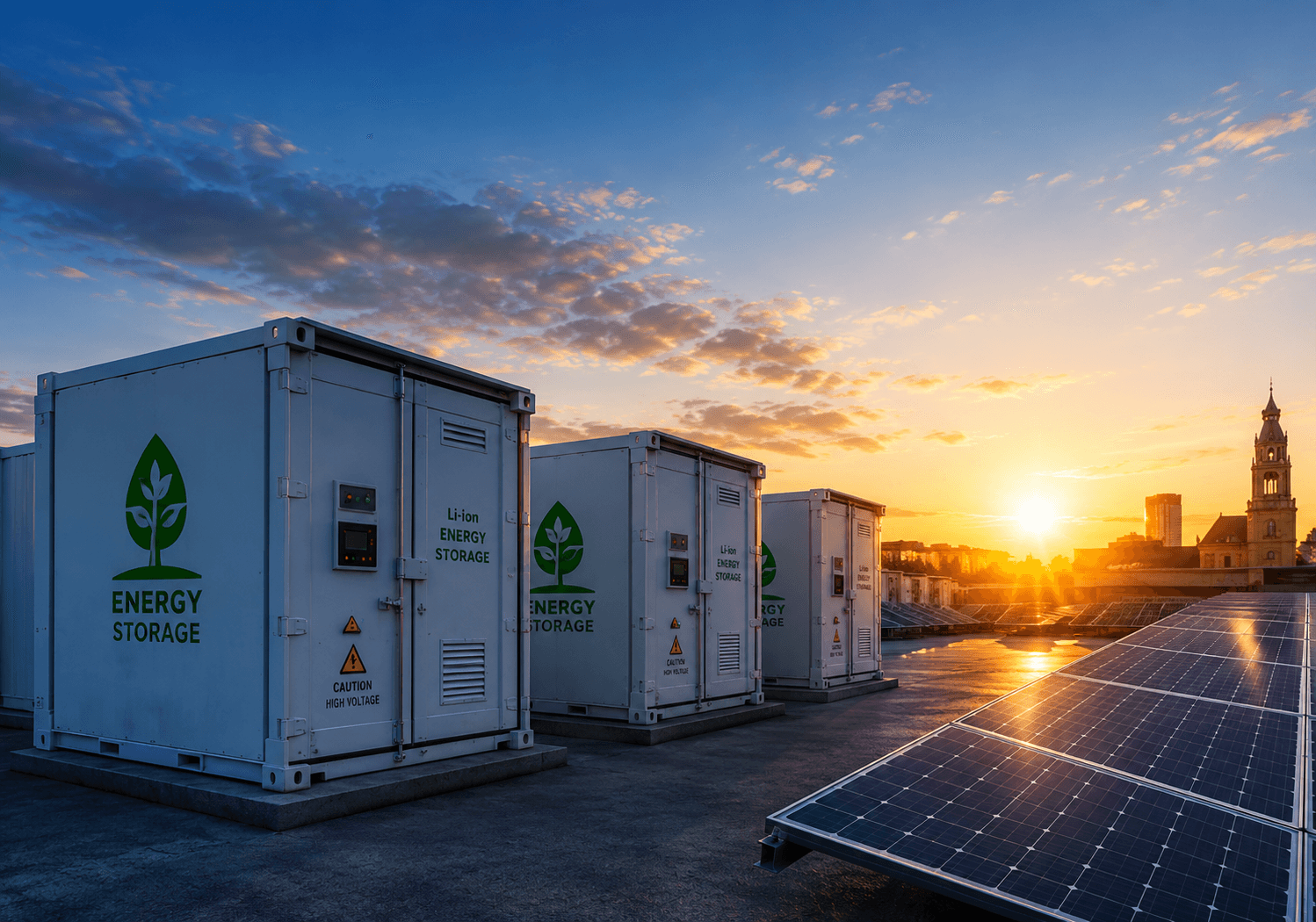
The integration of battery energy storage with solar generation fundamentally transforms the energy equation. Together, solar and storage create a system that generates, stores and dispatches energy according to demand requirements rather than generation availability. This architecture enables true energy management — the ability to control when energy is consumed, from which source, and at what cost.
This article examines the architecture of integrated solar-plus-storage systems, their industrial applications, financial and sustainability implications and the roadmap for building future-ready industrial energy infrastructure.
The Limitations of Standalone Solar
Understanding why integration matters begins with understanding what solar alone cannot do:
Solar generation ceases at sunset, while industrial operations often continue across evening and night shifts
Peak demand events — large motor startups, high-load production cycles — often occur outside peak solar hours, leaving demand charges unaddressed
Cloud cover creates intermittent generation dips that disrupt processes sensitive to power quality fluctuations
Surplus midday generation, if not consumed, is either exported at low compensation rates or wasted entirely where net metering caps apply
Solar alone provides no backup capability during grid outages
Each of these limitations represents an energy management gap that battery storage specifically addresses. The integration of the two technologies creates a system whose combined capability substantially exceeds the sum of its parts.
Solar Plus Storage System Architecture
A well-designed industrial solar-plus-storage system integrates several core components:
Solar Generation Array
The solar PV array captures sunlight and converts it to DC electricity. System sizing in a solar-plus-storage configuration accounts for both direct consumption requirements and the need to charge the battery system — typically requiring slightly larger array capacity than a solar-only system serving the same load.
Battery Energy Storage System
The battery system — typically using Lithium Iron Phosphate (LFP) chemistry for industrial applications — stores surplus solar generation and dispatches it according to the programmed energy management strategy. Capacity is sized based on the energy storage requirement: the volume of energy that must be shifted from periods of excess generation to periods of high demand or grid scarcity.
Hybrid Inverter / Power Conversion System
The hybrid inverter manages bidirectional power flow between the solar array, battery system, grid and facility loads. It enforces the energy management logic — deciding in real time whether to charge the battery from solar, discharge the battery to supplement grid supply, or export to the grid — based on real-time data and pre-configured dispatch strategies.
Energy Management System
The EMS is the intelligence layer that orchestrates the entire system. Advanced EMS platforms incorporate tariff data, weather forecasts, production schedules and real-time grid signals to optimize dispatch decisions dynamically, maximizing financial value from the combined asset.
Peak Demand Reduction
Demand charges — levied on the highest demand recorded within a billing period — can represent 30 to 50 percent of an industrial electricity bill. Solar generation alone does not reliably address demand peaks, which are often driven by shift changeovers, motor startup sequences or production peaks that may not coincide with peak solar output.
Battery storage addresses this directly through demand limiting algorithms — detecting when demand approaches the tariff threshold and injecting stored power to prevent the peak from being registered. For facilities with high demand charge exposure, demand management alone can justify a significant portion of the battery storage investment.
Backup Power and Grid Resilience
Grid reliability in India's industrial areas has improved significantly in recent years, but remains a source of operational risk in many regions. An integrated solar-plus-storage system with island mode capability provides seamless backup power — transitioning from grid-connected to island mode within milliseconds when a grid outage is detected, without production interruption.
This capability has direct financial value for facilities where even brief power interruptions cause significant losses: spoiled batches in food or pharmaceutical manufacturing, lost tool positions in precision machining, data loss in industrial computing, or cascading process failures in continuous operations.
Open Access Integration
India's evolving open access framework — which allows large power consumers to purchase electricity from generators other than their local DISCOM — creates additional strategic opportunities for integrated solar-plus-storage systems.
Under open access, industrial consumers can source power from renewable energy generators under long-term PPAs at fixed tariffs, often significantly lower than DISCOM retail rates. Battery storage enhances open access economics by enabling the storage of cheaper off-peak open access power for deployment during high-tariff peak periods, improving the blended cost of supply.
Microgrid Architecture
For industrial facilities with complex energy needs — multiple buildings, diverse process requirements, on-site generation from multiple sources — a microgrid architecture provides the highest level of energy control and resilience.
An industrial microgrid integrates solar generation, battery storage, potentially diesel generation backup, and controllable loads within a local distribution network that can operate both grid-connected and in island mode. The microgrid controller optimizes dispatch across all resources to minimize cost while maintaining reliability and power quality.
Microgrids are particularly relevant for industrial parks, SEZs, food processing clusters and pharmaceutical manufacturing campuses where multiple large energy consumers share infrastructure and can benefit from collective energy optimization.
EV Charging Integration
Industrial facilities are increasingly facing pressure to electrify their vehicle fleets — forklifts, material handling equipment, logistics vehicles and executive transport. EV charging at scale creates significant demand peaks if managed poorly.
Solar-plus-storage systems provide an intelligent platform for managed EV charging — scheduling charging to coincide with periods of high solar generation or low grid tariffs, using battery storage to buffer demand peaks from simultaneous charging events, and providing resilient power for charging infrastructure during grid disruptions.
As EV adoption accelerates across India's industrial sector, facilities that build integrated energy infrastructure with EV charging management capabilities will have significant operational and financial advantages.
Financial Benefits
The financial case for integrated solar-plus-storage rests on multiple value streams that, when combined, deliver compelling returns:
Energy cost reduction: Solar generation reduces grid power purchase volume at prevailing tariffs
Demand charge reduction: Battery storage prevents demand peaks from breaching tariff thresholds
Tariff arbitrage: Time-of-use optimization through charging during off-peak periods and discharging during peak tariff windows
Backup power avoided costs: Replacement or supplementation of diesel generator infrastructure with its associated fuel, maintenance and emissions costs
CBAM compliance benefit: Renewable energy generation directly reduces embedded emission intensity for export-oriented facilities
Blended payback periods for well-designed integrated systems in appropriate industrial contexts typically range from 4 to 8 years, with system lifespans of 20 to 25 years for solar and 10 to 15 years for the battery system.
Sustainability Benefits
Beyond the financial dimension, solar-plus-storage creates measurable sustainability outcomes increasingly relevant to industrial decision-makers:
Direct Scope 2 emission reductions from displacement of grid power with renewable generation
Elimination of diesel generator operation and associated Scope 1 emissions and local air quality impacts
Documented renewable energy consumption supporting Science-Based Targets (SBT) commitments and ESG disclosures
Improved green rating performance under IGBC, LEED or similar frameworks
Demonstrated progress against net zero roadmaps for organizations with published carbon reduction commitments
Future-Ready Energy Infrastructure Roadmap
Building energy independence is a multi-year journey. A phased roadmap enables organizations to manage capital deployment while progressively advancing their energy autonomy:
Phase 1: Foundation (Year 1)
Deploy rooftop or ground-mounted solar optimized for daytime self-consumption. Implement performance monitoring and data logging infrastructure. Conduct a comprehensive energy audit to identify the highest-value storage applications.
Phase 2: Storage Integration (Year 2-3)
Add battery energy storage sized for the highest-priority applications identified in the audit — typically demand management, backup power or time-of-use optimization. Implement hybrid inverter and EMS infrastructure with open architecture for future expansion.
Phase 3: Optimization (Year 3-5)
Integrate advanced EMS capabilities including AI-driven dispatch optimization, open access power procurement management and EV charging coordination. Explore green hydrogen production if scale and economics are appropriate.
Phase 4: Independence (Year 5+)
Achieve high levels of energy self-sufficiency with verified renewable energy consumption, active participation in grid services markets as they mature in India, and a demonstrated track record of energy cost reduction and carbon emission reduction that supports ESG reporting and CBAM compliance.
Industrial Use Cases
Automotive Components Manufacturing: Solar-plus-storage addresses shift changeover demand peaks, supports EV charging for logistics, and provides backup for quality-critical paint and coating processes.
Food and Beverage Processing: Continuous refrigeration power with zero interruption backed by storage, solar for daytime processing loads, and documented renewable energy consumption for export market sustainability requirements.
Pharmaceutical Manufacturing: Critical process protection through seamless backup power, solar for HVAC and utility loads, and renewable energy documentation for international regulatory submissions.
Textile Manufacturing: Demand charge reduction for heavy power consumers with electric motors and dyeing equipment, time-of-use optimization for multi-shift operations.
Data Centers and Colocation Facilities: Solar reduces PUE energy costs, storage provides UPS-quality backup at lower TCO than traditional UPS and diesel generator combinations.