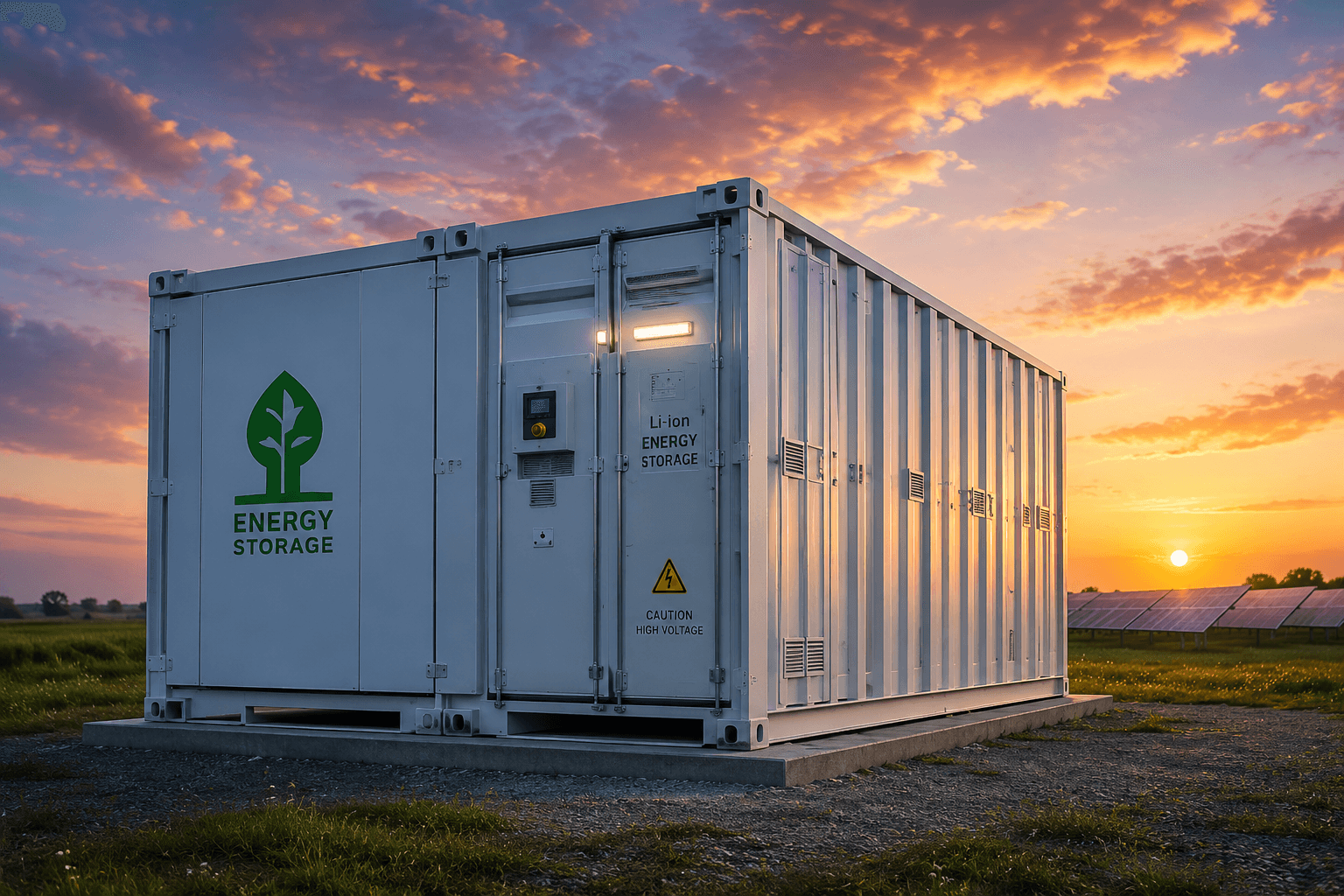
Discover how Battery Energy Storage Systems (BESS) work, their industrial applications, financial benefits and why they are essential for India's energy future.
Introduction
The global energy landscape is undergoing one of the most profound transformations in history. As industrial electricity tariffs continue to rise, grid reliability remains inconsistent and sustainability mandates tighten, businesses across India are evaluating smarter energy strategies. At the center of this conversation is one rapidly maturing technology: Battery Energy Storage Systems, or BESS.
No longer confined to pilot projects or utility-scale installations, BESS solutions are now commercially viable for commercial and industrial (C&I) facilities ranging from manufacturing plants and data centers to cold storage units and pharmaceutical complexes. Understanding how these systems work — and how they create tangible value — is essential for any business decision-maker navigating today's energy environment.
What Is a Battery Energy Storage System (BESS)?
A Battery Energy Storage System is an integrated technology solution that captures electrical energy, stores it in electrochemical form and releases it on demand. At its core, BESS acts as a controllable energy reservoir — charging during periods of low tariff or high generation and discharging when electricity costs peak or grid supply is unavailable.
Unlike traditional backup systems such as diesel generators, BESS operates silently, produces no direct emissions and delivers power within milliseconds. This near-instantaneous response makes it particularly valuable for facilities where even brief power interruptions cause significant production losses or quality failures.
What Happens Inside a Battery Storage System?
Understanding the internal architecture of a BESS helps decision-makers evaluate vendor proposals, compare technologies and plan infrastructure upgrades effectively.
Battery Modules
The foundation of any BESS is the battery cell — the electrochemical unit that stores and releases energy. Industrial systems primarily use Lithium Iron Phosphate (LFP) chemistry, selected for its superior thermal stability, long cycle life (typically 4,000 to 6,000 cycles) and tolerance for deep discharge. Cells are grouped into modules and then into racks, which form the battery cabinet.
Battery Management System (BMS)
The BMS is the intelligence layer of the battery stack. It continuously monitors cell voltage, temperature and state of charge, preventing overcharging, deep discharge and thermal runaway. A sophisticated BMS also performs cell balancing — redistributing charge across cells to maximize pack longevity and consistent performance.
Power Conversion System (PCS)
The PCS, or inverter, is the interface between the DC battery and the AC electrical network of your facility. It governs charge and discharge rates, synchronizes with the grid frequency and manages bidirectional power flow. Modern PCS units also support reactive power compensation, improving overall power quality.
Energy Management System (EMS)
The EMS serves as the command center, orchestrating when and how the battery charges and discharges based on pre-configured strategies, real-time tariff data, solar generation forecasts and load profiles. An advanced EMS can integrate with SCADA systems, building management platforms and utility signals.
Thermal Management and Safety Systems
Industrial BESS installations include liquid or air cooling, smoke detection, fire suppression and containerized enclosures rated for harsh industrial environments. Robust thermal management directly extends battery life and is a non-negotiable requirement for safe operation.
How BESS Supports Energy Independence
Energy independence does not mean disconnecting from the grid. For most industrial facilities, it means achieving the ability to manage when and how much grid power is consumed, reducing vulnerability to tariff volatility and supply disruptions. BESS enables this through three primary operating modes:
Peak Shaving
Many industrial tariff structures include a demand charge — a fee based on the highest 15-minute or 30-minute power demand recorded during the billing cycle. A single production surge can inflate demand charges for the entire month. BESS addresses this by detecting when demand approaches the contractual threshold and injecting stored power to flatten the curve, directly reducing the demand charge component of the electricity bill.
Time-of-Use Optimization
In time-of-use tariff structures, electricity is priced differently depending on the hour of consumption. BESS charges during off-peak periods — typically late night or early morning — when tariffs are lowest, then discharges during peak periods when tariffs are highest. For a large C&I consumer, this arbitrage can generate meaningful savings on a recurring monthly basis.
Backup Power
Unlike diesel generators that require fuel procurement, maintenance and warm-up time, BESS provides instantaneous backup power with zero emissions. For facilities with critical processes — pharmaceutical manufacturing, semiconductor production, food processing — this reliability has direct financial and quality assurance implications.
Solar Plus Storage Integration
When paired with rooftop or ground-mounted solar, BESS captures surplus generation that would otherwise be wasted or exported at low compensation rates. This stored solar energy is then deployed during evening hours or high-tariff periods, dramatically improving the economics of solar investments and extending effective solar utilization beyond daylight hours.
Grid Stability Services
At scale, BESS installations can participate in ancillary service markets — providing frequency regulation, voltage support and spinning reserve to grid operators. While still emerging in India, these revenue streams add another dimension to the financial case for BESS.
Financial Benefits for Industrial Facilities
The financial logic for BESS in industrial settings has become increasingly compelling. A well-designed system can deliver returns across multiple value streams simultaneously:
Reduction in monthly demand charges by 15 to 30 percent depending on facility load profile
Savings on energy arbitrage through time-of-use optimization
Avoided costs from power interruptions, including production losses and equipment damage
Extension of solar investment value through increased self-consumption
Potential revenue from grid services as regulatory frameworks mature
Typical payback periods for well-structured C&I BESS installations in India range from 4 to 7 years, with system lifespans of 10 to 15 years. As battery costs continue to decline — having fallen approximately 85 percent over the past decade — the financial case will only strengthen.
Industrial Applications of BESS
Battery storage is not a one-size-fits-all technology. Different industries leverage BESS capabilities in ways tailored to their operational realities:
Manufacturing Plants: Eliminate demand charge spikes caused by heavy machinery startups and coordinate energy supply across multi-shift operations.
Data Centers: Provide UPS-grade backup power with significantly lower operating costs and a smaller carbon footprint than diesel alternatives.
Cold Chain and Refrigeration: Maintain uninterrupted power for temperature-sensitive storage while optimizing energy costs across around-the-clock operations.
Hospitals and Healthcare: Deliver critical backup power with hospital-grade reliability while integrating with existing power infrastructure.
Chemical and Pharmaceutical: Protect sensitive processes from power quality disturbances and supply interruptions.
The Future of Energy Storage in India
India's BESS market is at an inflection point. The Ministry of New and Renewable Energy has established ambitious targets for grid-scale and distributed storage deployment as part of the country's broader clean energy agenda. As renewable energy penetration increases — particularly solar and wind — the intermittency challenge makes storage infrastructure not just beneficial but essential for grid stability.
Policy developments, including the Viability Gap Funding (VGF) scheme for BESS projects and evolving open access regulations, are creating a more favorable commercial environment. For C&I consumers, this means access to aggregated storage solutions, improved financing options and increasingly competitive system costs.
Businesses that invest in understanding and deploying BESS today position themselves ahead of competitors who will eventually be compelled by economics or regulation to follow.
Key Takeaways
BESS captures, stores and releases electricity on demand — enabling demand charge reduction, tariff arbitrage and reliable backup power.
Lithium Iron Phosphate (LFP) chemistry dominates industrial BESS deployments for its safety, longevity and performance characteristics.
Peak shaving and time-of-use optimization are the primary financial value drivers for C&I facilities.
Solar plus storage integration dramatically improves self-consumption and extends the value of renewable energy investments.
India's BESS market is growing rapidly, supported by policy incentives and falling battery costs.
Frequently Asked Questions
Q1: What is the difference between BESS and a traditional UPS system?
A traditional UPS system is designed for very short-duration backup power — typically minutes — to allow for an orderly shutdown or generator startup. BESS, by contrast, is engineered for sustained energy storage over hours, optimized for economic dispatch decisions such as peak shaving and time-of-use arbitrage, and capable of daily cycling over many years. BESS also integrates with solar and grid systems in ways that legacy UPS technology cannot.
Q2: How long can a BESS power an industrial facility?
Duration depends entirely on battery capacity (measured in kilowatt-hours or MWh) and the facility's power demand (measured in kilowatts or MW). A 500 kWh system powering a 250 kW load would provide two hours of backup. System sizing is determined through detailed energy audits and load analysis — there is no universal answer. Industrial systems typically range from 30 minutes to 4 hours of backup capacity depending on design objectives.
Q3: What is the lifespan of an industrial BESS?
LFP-based BESS systems are typically rated for 4,000 to 6,000 charge-discharge cycles with 80 percent capacity retention. For a facility cycling the system once daily, this equates to 11 to 16 years of operational life. Actual lifespan depends on operating temperature, depth of discharge and the quality of the Battery Management System. Regular preventive maintenance further extends system longevity.
Q4: Is BESS financially viable for mid-sized manufacturing facilities in India?
Yes, particularly for facilities with high demand charges or facilities operating in high-tariff states. The financial case is strongest where demand charges represent a significant portion of the monthly electricity bill, where time-of-use tariff differentials are substantial, or where solar integration is planned. A detailed financial model incorporating site-specific tariff structures and load profiles is essential for accurate ROI projections.
Q5: What certifications and standards should a BESS meet for industrial deployment in India?
Industrial BESS installations should comply with relevant Bureau of Indian Standards (BIS) requirements, IEC 62619 for battery safety, UL 9540 for energy storage systems, and local electrical inspector approvals. Enclosures should meet appropriate IP ratings for the installation environment. Ensure that vendors provide system-level certifications, not just component-level compliance documentation.
Conclusion
Battery Energy Storage Systems represent a fundamental shift in how industrial facilities manage energy — moving from passive consumption to active optimization. As India's energy landscape continues to evolve, BESS provides businesses with the tools to control costs, ensure operational continuity and build genuine energy independence.
The technology is proven, the economics are improving and the strategic case is clear. The question for industrial decision-makers is not whether to explore BESS — but how to design the right system for their specific operational context.